
Improve Your Spine Health by Improving Your Posture
Improve Your Spine Health by Improving Your Posture
Do you find your back and neck getting stiff and sore at the end of the day? Do you notice your mood feels worse after sitting slumped over your computer? If so, your posture may be to blame.
At King Physical Therapy, our physical therapists can help determine if your posture is the problem and how to restore it for a healthy spine!
Your body was made to move, especially your spine. It is typical for areas of your spine to tighten up, placing too much strain on other areas. When this happens, those areas can become irritated and painful.
Too often, we spend our time staring at a computer screen, hunched over our desks, or looking down at our phones. These postures create a lot of stress on our spine. The worse your posture is, the more intense your back and neck pain, the harder it is to breathe, and the worse your mood becomes.
Fortunately, King Physical Therapy can help ease some of these stressors. Specialized hands-on techniques and targeted exercises can help restore mobility and strength in your spine and improve your posture.
Our dedicated physical therapists can teach you how to correct your posture and bring you relief before it becomes a significant problem! Call today to make an appointment.
What exactly is good posture?
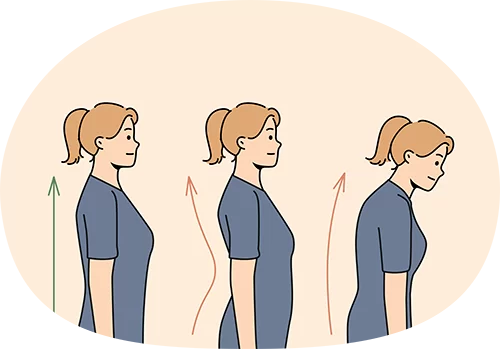
When people think of posture, they usually imagine someone sitting tall or perhaps slumped. Or they imagine someone standing tall at attention (like in the military). Posture is the position(s) of a person’s body in space. This includes how we move, like our lifting postures or reaching postures.
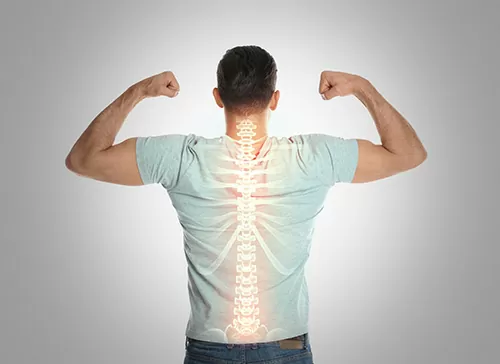
When the spine is in its natural position, the vertebrae stack up over one another. This is what people call “good posture” (also referred to as a neutral spine). This neutral spine posture allows the body to absorb and distribute stresses from everyday activities such as sitting, standing, walking or more intense activities such as running and jumping.
Our spine is designed to move, which means our posture should also move. The spine does not like to remain in any one position for extended times. Our therapists can help teach you to find your neutral spine posture to counteract the slouching to alleviate your pain and improve your overall health!
What you can do to improve your posture
Prolonged slumping while standing or sitting can cause your back, hip/pelvis, and abdominal muscles to become strained and painful. Poor postural habits also impact your overall health by reducing your cardiovascular function, inhibiting your breathing, impacting your balance and gait, and harming your overall mood.
Our highly trained therapists can educate you about your posture’s impact on your body and teach you simple skills to find and maintain a neutral spine. For example, when you’re standing, imagine your breast bone is lifted towards the sky. This will naturally cause your spine to straighten out — lifting you up — keeping your hips, spine, shoulders, and neck aligned.
Prolonged sitting is the position that puts significant pressure on the lower back. It is essential to break up your sitting time throughout the day and take frequent breaks. Schedule standing or walking activities at various times throughout the day to ensure you limit your sitting to about 45-60 minutes at a time.
How can physical therapy help my posture?
Physical therapy is the right solution to improving your posture and spinal health. Our physical therapists are experts in evaluating posture and movement. By pinpointing the source of your aches and pains, we can develop a plan for you that will return you to an ideal posture and quickly relieve your pain.
It is normal for people to lose a sense of how their postural muscles work and contribute to the health of their spine. These muscles become weak and uncoordinated with prolonged sitting, before/after pregnancy, and after surgeries or injuries.
Strength training exercises have been shown to help improve our overall posture. It is vital to make sure your core muscles (i.e., hip/pelvis, back, and abdominal muscles) are strong and integral to practicing proper posture.
Your therapist will teach you strategies like:
- Stand tall whenever you are standing or walking.
- Use support when you sit to keep your posture correct.
- Maintain a straight spine when you lift heavy objects.
We can help you mobilize your spine and strengthen the surrounding muscles to alleviate the pain associated with your poor postural habits.
Improve your posture with King Physical Therapy today!
Get back to your optimum health by consulting with a licensed physical therapist. We’ll help you achieve the strong spine health you need. Contact our office today to get started on the path toward better posture and decreased pain!
Join Us for a Healthier You – Book Today!
Achieve your health goals at King Physical Therapy—reserve your session today!
Our Patients Get Great Results
“Suzanne has been my therapist. She is absolutely wonderful she listens to your concerns and pains and immediately works on the area of distress. I had a total hip replacement and am so grateful for the outcome of the therapy at King.“
– Connie S.
Backpack Safety
Backpack Strategies for Parents and Students
Aching backs and shoulders? Tingling arms? Weakened muscles? Stooped posture? Does your child have these symptoms after wearing a heavy school backpack? Carrying too much weight in a pack or wearing it the wrong way can lead to pain and strain. Parents can take steps to help children load and wear backpacks the correct way to avoid health problems.

Loading the backpack:
• A child’s backpack should weigh no more than about 10% of his or her body weight. This means a student weighing 100 pounds shouldn’t wear a loaded school backpack heavier than about 10 pounds.
• Load heaviest items closest to the child’s back (the back of the pack).
• Arrange books and materials so they won’t slide around in the backpack.
• Check what your child carries to school and brings home. Make sure the items are necessary for the day’s activities.
• If the backpack is too heavy or tightly packed, your child can hand carry a book or other item outside the pack.
• If the backpack is too heavy on a regular basis, consider using a book bag on wheels if your child’s school allows it.

Wearing the backpack:
• Distribute weight evenly by using both straps. Wearing a pack slung over one shoulder can cause a child to lean to one side, curving the spine and causing pain or discomfort.
• Select a pack with well-padded shoulder straps. Shoulders and necks have many blood vessels and nerves that can cause pain and tingling in the neck, arms, and hands when too much pressure is applied.
• Adjust the shoulder straps so that the pack fits snugly on the child’s back. A pack that hangs loosely from the back can pull the child backwards and strain muscles.
• Wear the waist belt if the backpack has one. This helps distribute the pack’s weight more evenly.
• The bottom of the pack should rest in the curve of the lower back. It should never rest more than four inches below the child’s waistline.
• School backpacks come in different sizes for different ages. Choose the right size pack for your child as well as one with enough room for necessary school items.
• Only put items in your backpack that you need for the day.

Thank you for subscribing!
Discover Healthy Plate Pleasures
Homemade Black Bean Veggie Burgers
Ingredients
- 1 (16 ounce) can black beans, drained and rinsed
- ½ green bell pepper, cut into 2 inch pieces
- ½ onion, cut into wedges
- 3 cloves garlic, peeled
- 1 egg
- 1 tablespoon chili powder
- 1 tablespoon cumin
- 1 teaspoon Thai chili sauce or hot sauce
- ½ cup bread crumbs
Directions
- If grilling, preheat an outdoor grill for high heat, and lightly oil a sheet of aluminum foil. If baking, preheat oven to 375 degrees F (190 degrees C), and lightly oil a baking sheet.
- In a medium bowl, mash black beans with a fork until thick and pasty.
- In a food processor, finely chop bell pepper, onion, and garlic. Then stir into mashed beans.
- In a small bowl, stir together egg, chili powder, cumin, and chili sauce.
- Stir the egg mixture into the mashed beans. Mix in bread crumbs until the mixture is sticky and holds together. Divide mixture into four patties.
- If grilling, place patties on foil, and grill about 8 minutes on each side. If baking, place patties on baking sheet, and bake about 10 minutes on each side.
Meet Our Team

Karla King
PT, MPT, Cert. MDT

Suzanne Gregory
PT, MPT

Monique Mangram
Office Staff